

AI Tools for Digital Marketing in 2026: The Stack That Actually Gets You Hired
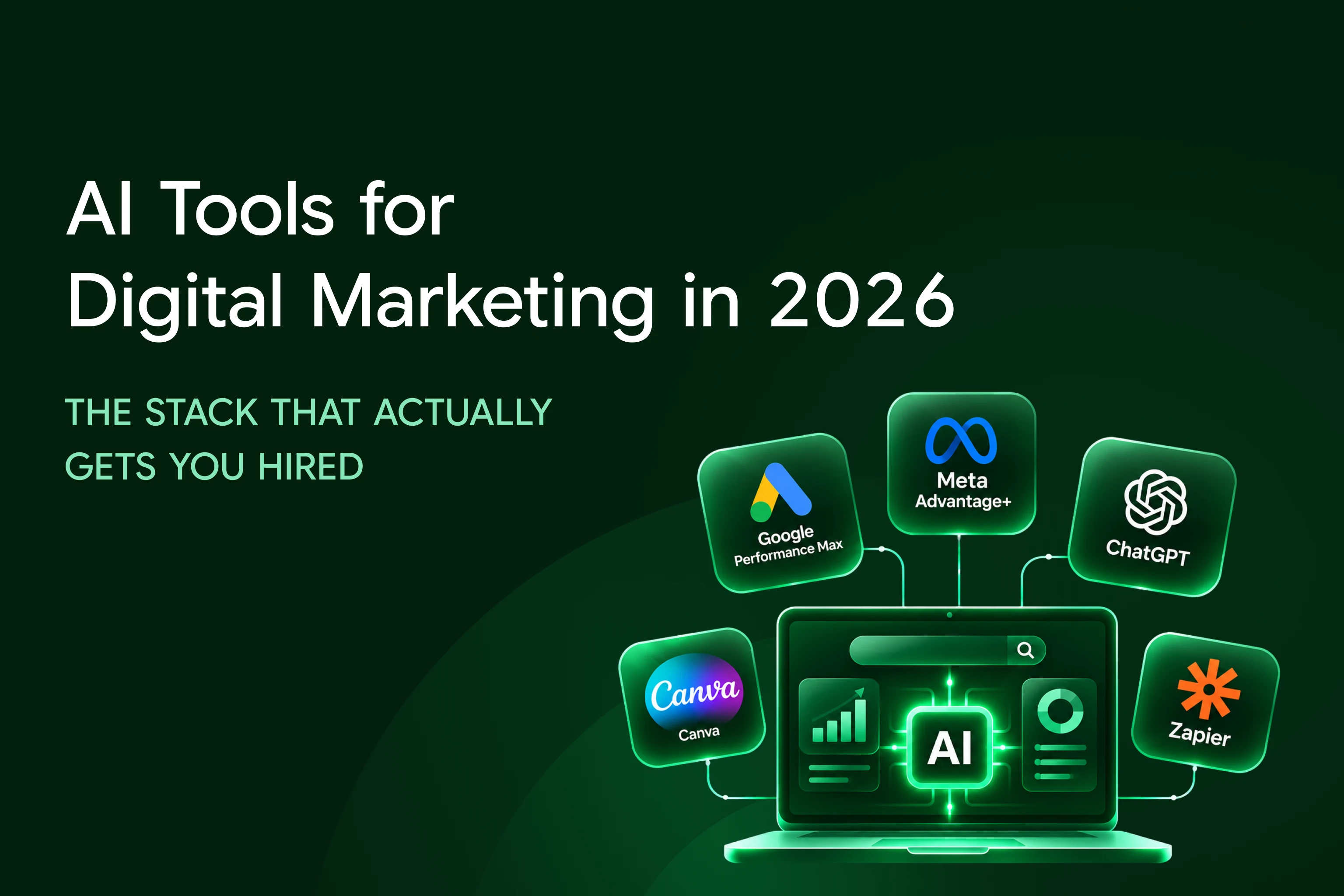
A working AI marketing stack in 2026 has five layers:
- The ad platforms that run their own AI (Google Performance Max, Meta Advantage+)
- The measurement that feeds them (GA4, Tag Manager, Conversions API)
- Creative generation at volume (Canva, Firefly, CapCut, Runway)
- A reasoning layer for research and analysis (ChatGPT, Claude, Gemini)
- Automation to connect it all (n8n, Make, Zapier)
Learning the measurement layer first matters more than collecting tools.
Search for "AI marketing tools" and you will find a hundred lists of fifty tools. Most are written by companies selling one of the tools, and most rank their own product first. None of them tell you the thing that actually matters: the tools are not the skill. The skill is knowing which job each tool does, and in what order the jobs happen.
So here is the stack organised the way the work actually happens. There are five layers, each with what it is for and what happens when you get it wrong.
Layer 1: The platforms already doing the AI
Start here, because this is the layer most "AI tools" lists ignore entirely while selling you add-ons.
Google and Meta have both moved their advertising products to AI-driven defaults. On Google that means Performance Max and its newer search-side equivalents, which take your assets and goals and decide placement, bidding and targeting themselves. On Meta it means Advantage+, which does the same across audience, placement, budget and creative variation.
What this changed about the job: the manual levers a media buyer used to be valued for (bid adjustments, placement exclusions, granular audience building) are mostly gone or automated. Google's own reporting on these products talks about double-digit conversion improvements. Those are vendor figures, though, so treat them as a direction rather than a guarantee.
What it did not change: the algorithm still needs to be told what a good outcome is, fed accurate signal, and given something worth showing people. Those jobs belong to the next two layers.
Learn, in this order:
- Google Ads: campaign structure, asset groups, how Performance Max actually allocates
- Meta Ads Manager and Advantage+: campaign objectives and what each one optimises towards
- LinkedIn Ads, if you are heading towards B2B
Layer 2: Measurement, which is where most people fail
This is the unglamorous layer that decides whether everything above works. Automated bidding optimises towards the signal you give it. Give it a bad signal and it will optimise, efficiently and expensively, towards the wrong thing.
A real example of how this goes wrong: a business sets its conversion event as "page view on thank-you page", but the thank-you page also loads when someone abandons a form halfway. The algorithm now learns to find people who half-fill forms. Spend rises, reported conversions rise, but actual enquiries do not. Nobody notices for two months.
The tools in this layer:
- Google Analytics 4: events, conversions, and what GA4 counts differently from its predecessor
- Google Tag Manager: deploying and debugging tracking without waiting on a developer
- Meta Pixel and the Conversions API: server-side signal, which matters more every year as browser tracking degrades
- Google Search Console: the only honest view of organic search performance
- Looker Studio: turning all of it into something a client will actually read
If you learn one layer properly, learn this one. It is the layer that gets juniors promoted, because very few people enjoy it and almost every team needs it.
Our Digital Marketing course in Trivandrum teaches this stack on live client campaigns, not demo accounts. That includes setting up tracking from scratch and being responsible for whether the numbers are right. Book a free 15-minute call.
Layer 3: Creative generation, at volume
Platform AI now handles targeting, so creative has become the main competitive lever. When several advertisers feed the same automated system, the differentiator is what the ad says and how it looks.
That has made volume a requirement. Where a campaign once ran three creatives for a month, it now needs fifteen variants tested over a fortnight. No small team produces that by hand. That is the job the generative tools do:
- Canva Magic Studio: fast resizing and variant generation across placements
- Adobe Firefly and Ideogram: image generation, with Ideogram notably better at legible text inside images
- CapCut: short-form video editing and captions, the format that dominates paid social
- Runway: video generation and editing for motion concepts
- HeyGen: avatar and voice video, useful for multilingual variants
The trap in this layer is thinking the tool replaces taste. It does not. Generative tools produce competent, generic output by default, and that is exactly what everyone else's tool is also producing. The marketer who can tell a good layout from a bad one, and who understands hierarchy and contrast, gets more from these tools than the one who accepts the first result. That is why we teach design fundamentals alongside our graphic design and video track rather than treating creative as a separate department.
Layer 4: The reasoning layer
ChatGPT, Claude and Gemini are not creative tools and not analytics tools. They are thinking tools, and in marketing they earn their keep on four jobs:
- Research synthesis: reading twenty competitor pages and telling you what claims everyone makes, so you can make a different one
- Account auditing: pasting in exported campaign data and asking what looks wrong
- Copy drafting at variant scale: twelve headline angles in a minute, of which you use two
- Structured extraction: turning messy input into the format a spreadsheet or feed needs
What they are poor at: knowing your client's business, inventing a genuinely new positioning, and anything that needs current data they have not been given. A marketer who treats model output as a first draft does well. One who treats it as finished work produces the bland copy that is now everywhere.
Layer 5: Automation and plumbing
The final layer connects the others so a two-person team can run like a five-person one:
- n8n, Make, Zapier: moving leads from an ad form into a CRM, a sheet and a WhatsApp notification without anyone copying and pasting
- WhatsApp Business: in Kerala this is not a nice-to-have. For a great many local businesses it is the primary sales channel, and a lead that is not answered on WhatsApp within the hour is usually lost
This layer is where "I know AI tools" becomes "I built something that runs without me", which is a very different line on a CV.
One more shift worth knowing about
People increasingly ask AI assistants for recommendations instead of searching. Type "Best digital marketing course in Trivandrum" into ChatGPT and you get an answer, not ten links. That answer is assembled from sources the model can read and trust.
This is beginning to be called generative engine optimisation, and what it asks of you in practice is unglamorous: clear structure, direct answers to real questions, facts stated plainly and sourced, and content that reads like it was written by someone who knows the subject. Conveniently, that is also what has always made good content. If you are learning marketing now, assume part of your job will be making sure a machine can accurately describe what your client sells.
What AI still cannot do, and why juniors still get hired
If the platforms automate bidding and the models write the copy, why hire anyone?
Because none of it decides what to do. No tool will tell you that a client's real problem is their pricing page rather than their ad spend. No model knows that a Kerala jewellery buyer behaves differently in Onam season, or that a Gulf-resident audience responds to different proof than a domestic one. No automated system takes responsibility when the numbers go wrong in front of a client.
Judgement, context and accountability are the job. The tools are how you execute it. The candidates getting hired are the ones who can show both: a stack they can operate and a campaign they were answerable for.
If you are still deciding which side of marketing to start on, read performance marketing vs digital marketing.
Marvelloux Academy's AI-integrated Digital Marketing course runs inside Technopark, Trivandrum: four months of training plus a two-month Studio Agency Internship where you run live campaigns for real client businesses. Maximum 30 students per cohort, one mentor for every 15. Book a free call.
Frequently asked questions
Which AI tool should a digital marketing beginner learn first?
Not a generative tool. Learn Google Analytics 4 and Google Tag Manager first. Automated ad platforms optimise towards whatever signal you give them, so the ability to set up accurate measurement is worth more than any creative tool, and far fewer people have it.
Will AI replace digital marketing jobs?
It has already replaced parts of them: manual bidding, placement management and basic copy production are largely automated. What has not been replaced is deciding what campaign to run, judging whether creative is any good, interpreting results in business context, and being accountable for the outcome. Roles are shifting rather than disappearing.
Do I need paid subscriptions to learn AI marketing tools?
Mostly no. Google Ads, Meta Ads Manager, GA4, Tag Manager, Search Console and Looker Studio are free to use, and you pay only for ad spend. Canva, CapCut and the major AI assistants all have usable free tiers. The expensive tools are agency-tier analytics platforms, which you will learn on the job rather than before it.
What is generative engine optimisation (GEO)?
GEO means optimising content so AI assistants and AI search results describe and recommend you accurately. In practice it means clear structure, plainly stated facts, direct answers to the questions people actually ask, and sources a model can verify.
Is an AI digital marketing course worth it in Kerala?
It depends entirely on whether you touch live budgets. A course that teaches tool interfaces produces a certificate. A course where you run real campaigns for real businesses produces the campaign results an employer will ask you about in the interview. Ask any institute one question before paying: whose money will I be spending?
How long does it take to learn the AI marketing stack?
The interfaces take weeks. The judgement takes longer: most people need several months of running actual campaigns before their instincts are reliable. This is why programmes that end in a practical internship tend to produce job-ready candidates faster than those that end in an exam.